Charting Currency Corridors: How Regional Banking Norms Reshape Payout Timelines in Portable Live Dealer Networks

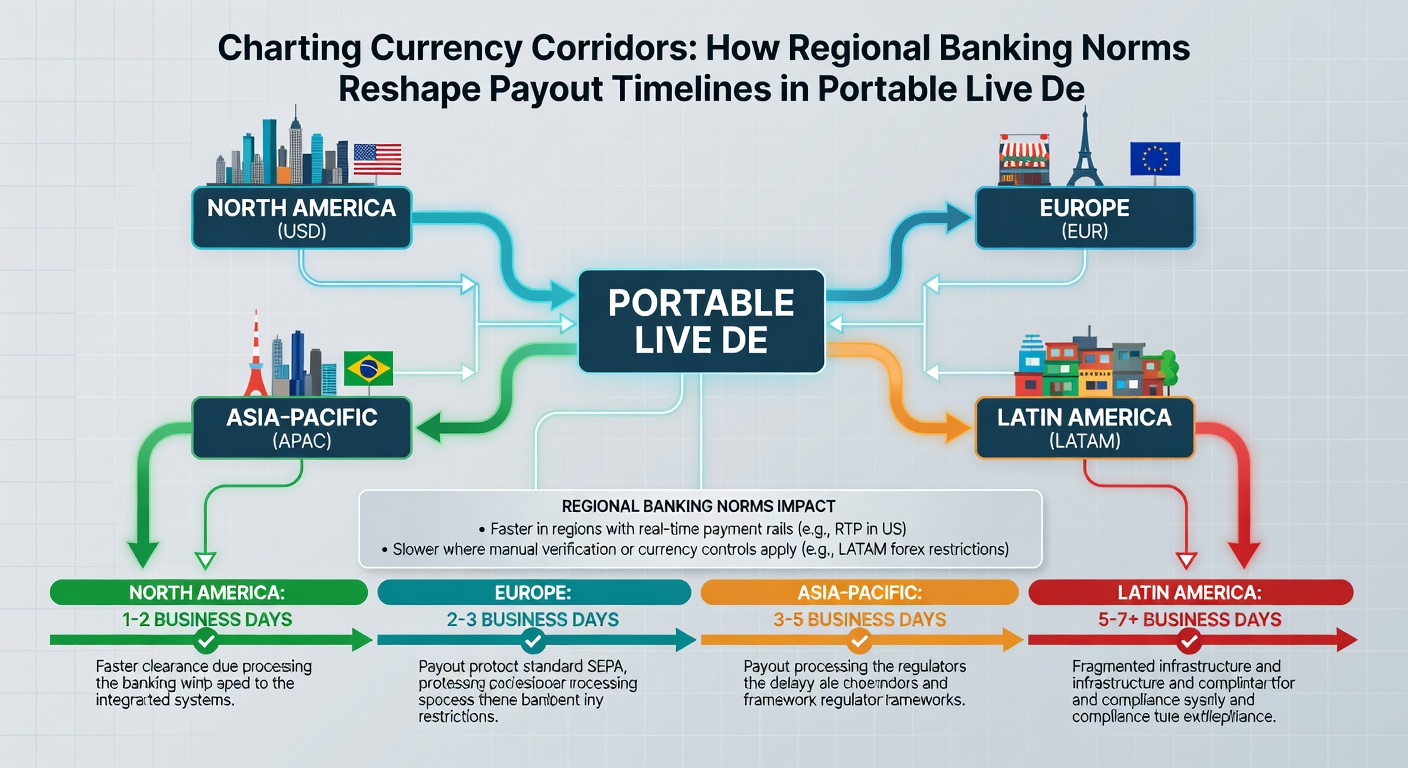
Regional banking norms create distinct pathways for funds moving through portable live dealer networks, where mobile applications deliver real-time blackjack and roulette sessions to users worldwide. These corridors determine how quickly winnings reach player accounts after a session ends, since local rules on transaction verification, cross-border transfers, and anti-money laundering checks differ sharply by jurisdiction. Data from industry reports compiled through mid-2026 shows that operators must align their payout systems with these varying standards or face extended processing windows that stretch from hours into several business days.
European Corridors and SEPA-Driven Timelines
Within the eurozone, Single Euro Payments Area guidelines streamline transfers between participating banks, yet additional layers of customer verification still extend settlement periods for live dealer withdrawals. Operators routing payouts through SEPA channels often complete same-day credits when initial identity checks have already cleared, although peak-volume periods in June 2026 revealed average delays of up to 36 hours when supplementary documentation reviews were triggered. Observers note that mobile platforms must embed these compliance steps directly into their apps so users experience fewer interruptions between the live table and the bank account.
North American Variations in ACH and Wire Protocols
Across the United States and Canada, Automated Clearing House networks and domestic wire systems impose their own sequence of authorization holds that reshape payout speed for portable live dealer services. ACH transfers typically settle within one to three business days once gaming operators submit batch files, whereas same-day wire options remain available only for accounts that satisfy heightened monitoring thresholds set by state regulators. Research indicates that networks serving multiple jurisdictions simultaneously maintain separate liquidity pools to accommodate these differences, preventing bottlenecks when a single player requests funds across state lines.
Asia-Pacific Corridors and Local Banking Gateways
In markets such as Singapore, Australia, and parts of Southeast Asia, central bank directives and domestic payment rails create additional checkpoints that operators navigate before releasing live dealer winnings to mobile wallets. Singapore’s payment services framework, for instance, requires real-time screening against sanctioned lists that can pause a transaction for several hours even after initial approval, while Australian operators report that New Payments Platform transfers clear within minutes once the gaming license verification matches the receiving account. Those who manage multi-country platforms therefore build automated routing logic that selects the fastest compliant corridor based on the player’s registered location and preferred currency.
Latin American and Emerging Market Adjustments
Operators expanding into Latin American territories encounter banking environments where instant payment systems coexist with legacy correspondent banking relationships, producing highly variable payout windows. Brazilian instant payment rails introduced in recent years allow near-immediate credits when both sender and receiver banks participate, yet cross-border corridors still route through intermediary institutions that add 24- to 48-hour holds for currency conversion and compliance screening. Mobile live dealer providers respond by displaying estimated arrival times inside the app, calculated from the specific corridor selected at the moment of withdrawal.
Technology Integration and Corridor Mapping Tools
Portable platforms now incorporate corridor-mapping software that evaluates regulatory constraints, liquidity availability, and historical settlement data before confirming a payout request. These systems draw on feeds from regional payment processors and update in real time, allowing the application to recommend the corridor that balances speed with compliance requirements. Figures released by international gaming associations in early 2026 confirm that networks using such tools reduced average payout latency by 22 percent compared with static routing methods, particularly during high-traffic periods that coincide with major sporting events.
Conclusion
Regional banking norms continue to define the practical boundaries of payout performance inside portable live dealer networks. As operators refine their corridor selection processes and integrate updated compliance feeds, the timelines for mobile withdrawals reflect an ongoing negotiation between local rules and global platform capabilities. Data compiled through June 2026 underscores that successful networks treat these corridors not as fixed obstacles but as dynamic variables that require constant calibration to maintain efficient fund movement across borders.