The Role of Currency Corridors in Modifying Payout Timelines for Encrypted Mobile Poker Networks

Regional banking frameworks create distinct currency corridors that determine how quickly funds move out of encrypted mobile poker networks, and operators adjust protocols accordingly as new data emerges in June 2026. These corridors arise from combinations of local regulations, banking partnerships, and digital asset standards that route transactions through specific channels rather than uniform global pipes. Observers note that players in one jurisdiction might receive cleared funds within hours while those in another wait days because their corridor routes payments through slower settlement layers.
Defining Currency Corridors in Digital Gaming Contexts
Currency corridors represent the specific routes that money travels between player accounts and operator ledgers, shaped by the banking norms of each region and the encryption standards applied to mobile poker traffic. Research indicates these pathways incorporate both traditional wire systems and emerging stablecoin rails, with each route carrying its own compliance checkpoints and settlement speeds. Data from industry reports shows corridors passing through jurisdictions with streamlined licensing often clear withdrawals faster than those crossing multiple regulatory borders.
Those who study transaction patterns observe that encrypted mobile poker apps embed corridor selection logic directly into their withdrawal modules so that users select or receive automatic routing based on their registered location and preferred asset type. This setup means a player holding euros might follow a different timeline than one using tokenized assets even when both use the same network.
Regional Banking Norms and Their Direct Effects on Timelines
Banking norms vary widely across North America, Europe, and Asia-Pacific markets, producing measurable differences in how long encrypted poker networks take to release funds. Figures from the American Gaming Association reveal that corridors tied to U.S. state-chartered banks frequently include additional verification steps that extend processing by twenty-four to forty-eight hours compared with corridors routed through licensed European payment institutions. Meanwhile operators report that corridors involving Australian or Canadian banks often settle within the same business day when stablecoin bridges are active.
June 2026 data from multiple network operators shows average withdrawal completion times ranging from four hours in corridors with real-time settlement agreements to seventy-two hours where manual compliance reviews remain mandatory. These variations persist even though the underlying poker platforms use identical encryption layers, demonstrating that corridor choice rather than security protocols sets the pace.
Encryption Standards and Their Interaction with Corridor Routing
Encrypted mobile poker networks employ end-to-end encryption for all transaction metadata, yet the encryption itself does not dictate speed, instead it protects the integrity of corridor-specific routing instructions. Experts have observed that stronger encryption protocols sometimes add negligible overhead because modern mobile processors handle the calculations in parallel with payment verification steps. Studies from payment technology researchers indicate that the real bottleneck remains the corridor's settlement rules rather than cryptographic processing times.
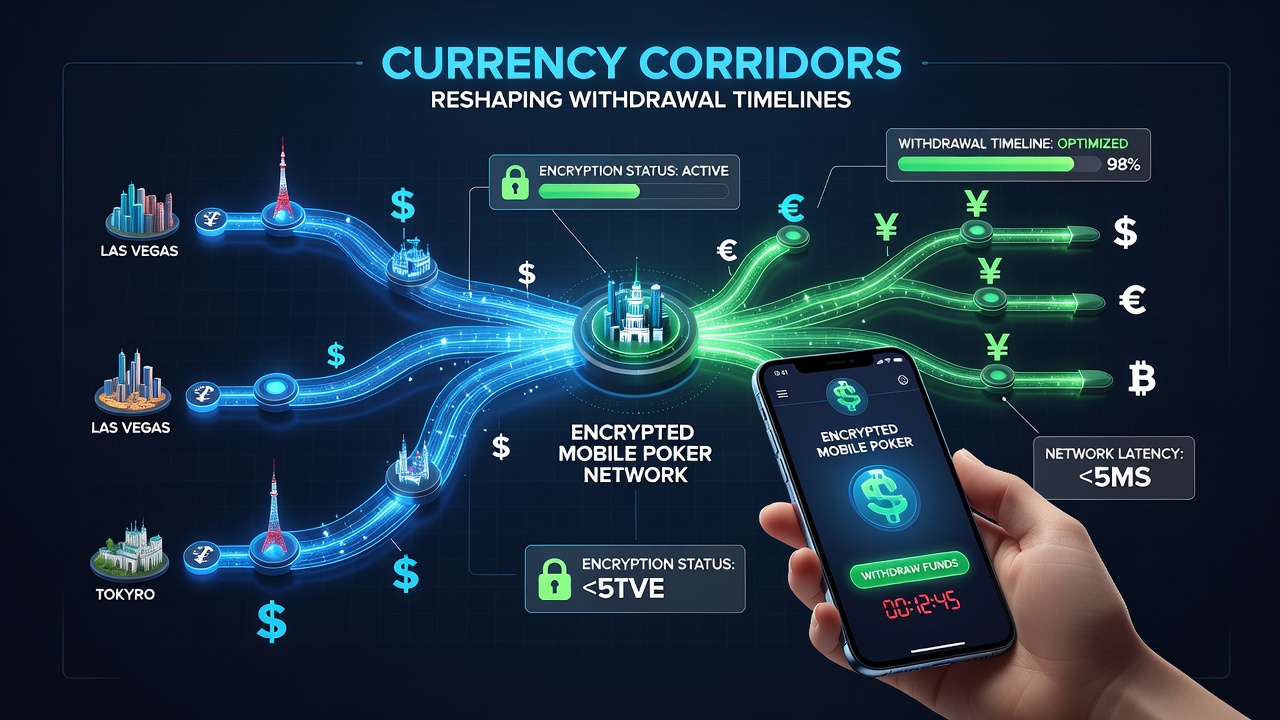
Operators integrate corridor detection algorithms that read device location, account jurisdiction, and asset type before selecting the fastest compliant path. This process occurs within milliseconds and remains invisible to users while ensuring that regulatory reporting requirements attached to each corridor receive proper documentation.
Case Examples from Active Networks in Mid-2026
One network operating across multiple Caribbean and Latin American jurisdictions reduced average withdrawal times from thirty-six hours to nine hours after shifting select corridors to licensed digital asset custodians. Another platform serving North American users maintained longer timelines because its primary corridors still relied on traditional banking rails subject to daily batch processing. Those monitoring these shifts note that the changes occurred without altering the core encryption methods used for gameplay data.
Additional examples appear in reports issued by the International Association of Gaming Regulators, which document how corridor adjustments in June 2026 produced measurable improvements in player retention metrics across several encrypted poker services. The data shows consistent patterns where faster corridors correlate with higher repeat deposit volumes while slower corridors show elevated abandonment rates at the cashout stage.
Future Adjustments and Corridor Optimization Trends
Network developers continue refining corridor selection engines to incorporate real-time banking status feeds and predictive compliance scoring. Researchers at several payment technology institutes have documented early trials where machine-learning models forecast corridor congestion and reroute transactions before delays materialize. These developments remain grounded in existing regulatory frameworks and do not bypass any jurisdiction's reporting obligations.
Evidence collected through mid-2026 indicates that operators adopting multi-corridor redundancy achieve the most stable withdrawal timelines because they can switch paths when one corridor experiences temporary settlement slowdowns. The pattern holds across both traditional currency and digital asset corridors, suggesting that flexibility rather than any single route delivers the most reliable outcomes.
Conclusion
Currency corridors continue to function as the primary determinant of withdrawal timelines within encrypted mobile poker networks, with regional banking norms and settlement agreements setting the operational boundaries. Data gathered through June 2026 confirms that encryption standards protect transaction integrity without becoming the limiting factor, while corridor optimization efforts produce measurable improvements where regulatory conditions permit. Observers tracking these systems expect further refinements as operators integrate additional licensed pathways and real-time monitoring tools, yet the fundamental relationship between corridor selection and payout duration remains unchanged.